Lesson 2 Art Hisotry B Final Unit 3 Final Exam
The Fine art History Myth
And so many students annals for an art history class with an inaccurate idea of what the subject entails. They believe it'due south a class for looking at pretty pictures all mean solar day and they'll be able to skate right through information technology. Notwithstanding, this is not the case. Fine art history covers far more than looking at pictures, and requires exceptional study skills if the goal is an "A" alphabetic character grade. In my experience as an fine art history student, I noticed three singled-out types of students in my classes:
- The art history major who needs and wants to study the discipline.
- The art major who is required to accept a certain amount of art history courses.
- And, the other random majors who needed an elective and thought that art history would be fun and easy.
Whatever their area of study, many students are completely shocked when they receive those first examination scores. Those C's, D's, and F's are e'er a quick slap in the face to those students who callously believed fine art history to be a fluff class. Sadly, fifty-fifty many students majoring in the subject struggle for high marks on exams because while they may be passionate almost the subject field matter, they simply don't know how to properly prepare for an exam.
Fifty-fifty past the time I was taking the upper level courses, many of my young man students still hadn't adopted good studying practices. Semester later semester they approached studying for exams in the same way; scrambling to memorize the content last infinitesimal while guzzling venti latté's at Starbucks in the student spousal relationship until two or three o'clock in the morning.
If y'all are currently taking an fine art history class, or planning on it, you'll probably hear students and even instructor's say, "Memorization is the primal." This is true to a bespeak. You lot will need to memorize titles, artist names, and dates, at to the lowest degree, but memorization tends to exist temporary cognition. Sitting down with a stack of flash cards and memorizing what's on them may be the quicker way to laissez passer the examination, just it is an excruciatingly Irksome way to study, and you'll forget everything by the next solar day.
My methods of studying accept a great deal more time. These are not methods for people who want to know how to pass an art history exam without putting in whatsoever piece of work. My study strategies are meant for the student - whether an fine art history major or a pupil of some other field - who wants to get an A and doesn't heed working diligently to get there.
My methods are also tried and true. I graduated magna cum laude with a degree in art history, and with the highest GPA of all the fine art history majors graduating with me. Those friends of mine who pulled the late nighters with the flash cards did not graduate with honors.
And then, my promise is, if you lot're willing to work for the form, I will give you the strategy that will go it for you. In the long run, your life will actually be easier come test time because you lot won't need to cram for the test; you lot'll already know the answers.
Art History Trivia
Some General Written report Tips
To begin, I'd like to introduce some full general good report habits:
-
Don't wait until right earlier the test to written report.
I've already alluded to this footstep, and while it seems most obvious, information technology is surprising how many people ignore this simple axiom. Time and time once again students attend grade and think their chore is done for the twenty-four hours.
Wrong!
There is a reason instructors create a syllabus outlining the schedule for the duration of the grade. Your form syllabi is non something you lot should toss into the garbage on your fashion out of the classroom on the first day. No, that certificate needs to become the basis of outlining your study schedule for the semester.
Staying on summit of your syllabus enables you to anticipate the upcoming topics. The best practice is to prepare for the lecture by reading the corresponding literature before the topic is covered. This manner, the lecture actually reinforces data you've already gained and aids in improve retention.
-
Take notes in course
Another obvious tip ignored by too many students. Taking notes in lecture classes is optimal for keeping one'due south listen engaged. Even if the instructor is covering details seemingly irrelevant to the matter at manus, take notes. Information technology keeps you focused, and the act of writing also helps with retaining knowledge.
Yes, I'thousand non just recommending notes, but I'chiliad suggesting you actually write them as opposed to typing them. For those of us brought up with computers, our typing skills are generally enough proficient for us to blazon and transcribe what a professor is saying without actually giving it any attention. But, that also makes it all too piece of cake to type what you hear without really listening.
And of class, there are the many distractions computers bring with them: Facebook, Pinterest, Twitter, electronic mail, Amazon, etc. While you lot're decorated checking your condition on Facebook, your instructor likely just gave the grade a crucial flake of information meaning the difference between getting an A on the essay portion of the test and not getting credit at all. If, for any reason, y'all still cull to use a computer in course, don't have Facebook or any of the other distracting sites open in some other tab. Those pesky notifications telling you something new has occurred are far too tempting to ignore, and before you know information technology you're checking your updates more than taking notes.
-
Written report in a place NOT comfortable.
The optimal location for studying, especially if you need to devote a good chunk of fourth dimension, is somewhere with no other activity options. The library, a repose bookstore café, or a coffee house make for great places to study. The environment is generally subdued, quiet, and they offer something to do while taking a study interruption without causing distraction.
Almost people have difficulty studying at home considering in that location are too many other things to practice. My apartment was never cleaner than when my college roommate had an assignment due or a exam coming up. Studying at home makes information technology too piece of cake to distract yourself with other important things that need to exist washed.
-
Listen to instrumental music while studying.
Most of usa have heard listening to classical music is best for while studying, just what if you lot don't like classical music? I too highly recommend listening to something to block out the noise of your environment, and I discover that music helps focus the mind and before you know it you've spent hours studying without even realizing time has passed. Merely, we don't all dig Beethoven and Mozart every bit background noise (personally I do, but I can sympathize this isn't for everyone's taste). If you're not in to classical tunes, endeavor listening to film scores. If you enjoy an edgier sound to your music, Steve Vai, Joe Satriani, Ynwei Malmsteen, Ethan Brosch, and many other guitarists have solo albums of purely instrumental compositions. Prefer a mix? Try Apocalyptica, 2 Cellos, or David Garrett.
-
Study in cycles of twenty to forty minutes with 5 to ten minute break-in between.
A four hour study session with no breaks is a ho-hum and frankly daunting task. If this is your idea of what studying entails, it's no wonder you avoid information technology. Dividing the job into smaller, more manageable chunks with five to 10 minute breaks to look forrard to will brand that overall four hour period a much more enjoyable feel.
When y'all take a break, do something non-chore oriented. This is when yous cheque Facebook or the other social media sites, maybe you get a snack or another cup of java, play candy crush on your iPhone, etc. But, don't permit your breaks distract y'all from returning to the task at paw. When break time is over, close out of whatever game or social media yous're using and get dorsum to business organization.
-
Don't always study lone.
Partnering with another member of your form has many advantages. Starting time, if yous missed a class or dozed off during a lecture, yous tin compare notes and make certain you're caught up. 2d, the active appointment of quizzing each other is less monotonous than reading chapter upon chapter in the text or using flash cards. Finally, if y'all get forth with your study partner(s) a lot of times these sessions feel more like hanging out, thus making studying far more entertaining.
To sum it up, these aren't all technically study tips, only more of an academic modus operandi. It's the aforementioned reasoning behind the idea that cleaning as you cook results in less kitchen mess later on the repast. Piece of work a little scrap conscientiously throughout the semester and you'll be sleeping like a baby the dark earlier the exam while the residual of your class burns themselves out and nearly overdoses on caffeine.
Art History Report Tips
Now, for the art history specific tips.
-
Flash cards.
If I've made it seem so far as if flash cards are dull and monotonous, I'g sorry. I'm sorry because, as irksome and monotonous as they can be, they're still the number one best report tool for fine art history. Remember, I did say that memorization does play a certain part up to a point, and flash cards are optimal for drilling the pertinent information - name, appointment, championship, style, location, etc. - into your head.
At that place is, of course, the old school way of making flash cards. Note cards with a printout of the prototype on one side and the corresponding details on the reverse side. Or, you tin use Keynote, or Power Signal if you accept a Windows automobile, to create a digital version of flash cards. On one slide you testify the paradigm, well-nigh of which can be found on Google Images or ARTstor, and enter the details on the next slide.
There are also unlike variations of online flash card programs. I personally never had any success with these and found them to be more of a waste of fourth dimension than helpful, simply if this is more to your liking yous can find plenty by searching for "flash carte maker" on Google.
-
Create a master list.
It may exist wiser to create this before you create the flash cards, merely either mode you'll need this to written report. For my own studying purposes, I always used Numbers (Excel for the Microsoft users out at that place), and I fabricated lists for Engagement, Title, Artist, Manner, Medium, Location, and Menstruum. Then I would enter each artwork covered in the session in engagement order from oldest to newest.
However, at that place are many ways to organize your lists. Depending on how you lot're beingness tested, or what information you're beingness tested on, you may want to grouping by artist, by period, by fashion, past medium, or by location. Creating this list is really up to your preferred manner of arranging information.
As you get together your list, leave room for notes. You lot will utilise this list in conjunction with your flash cards or Keynote/Power Bespeak file to annotate relative information to the images you are reviewing.
-
Expand your learning outside the classroom.
Don't stick to reviewing only your course notes. Wait up biographical information about each artist on the exam. It is probable more knowledge about the creative person will help you lot better sympathize their choices of subject matter, medium, and/or style. Contextual data will without a doubt help cement the where and the when. For example, knowing Leonardo Da Vinci, an Italian past birth, finished his career and life in France, may help you lot call back that La Joconde is in the Louvre, not Italy.
At that place is enough of contextual information available for many of the famous works in the history of art. Primary sources are all-time, but there are numerous secondary sources out there. So earlier the test, check out supplementary materials from the library or fifty-fifty utilize Google to find online articles about the material you're studying.
The pull a fast one on to truly being able to recognize and recall facts near artworks is to really know the data. Learning as much as you can about the artist, the time period, the individual works themselves will only help you retain the information more permanently. Follow these tips, and yous'll walk in to every test and confidently pass information technology with ease.
An Example of A Master Listing of Works to be Studied
| Engagement | Title | Artist | Medium | Style | |
|---|---|---|---|---|---|
| 1888 | The Dark Café | Vincent Van Gogh | Oil on Canvas | Mail service-Impressionism | |
| 1889 | Landscape with Wheat Sheaves and Rising Moon | Vincent Van Gogh | Oil on Canvass | Post-Impressionism | |
| 1889 | Starry Night | Vincent Van Gogh | Oil on Sail | Post-Impressionism |
Scroll to Continue
Read More From Owlcation
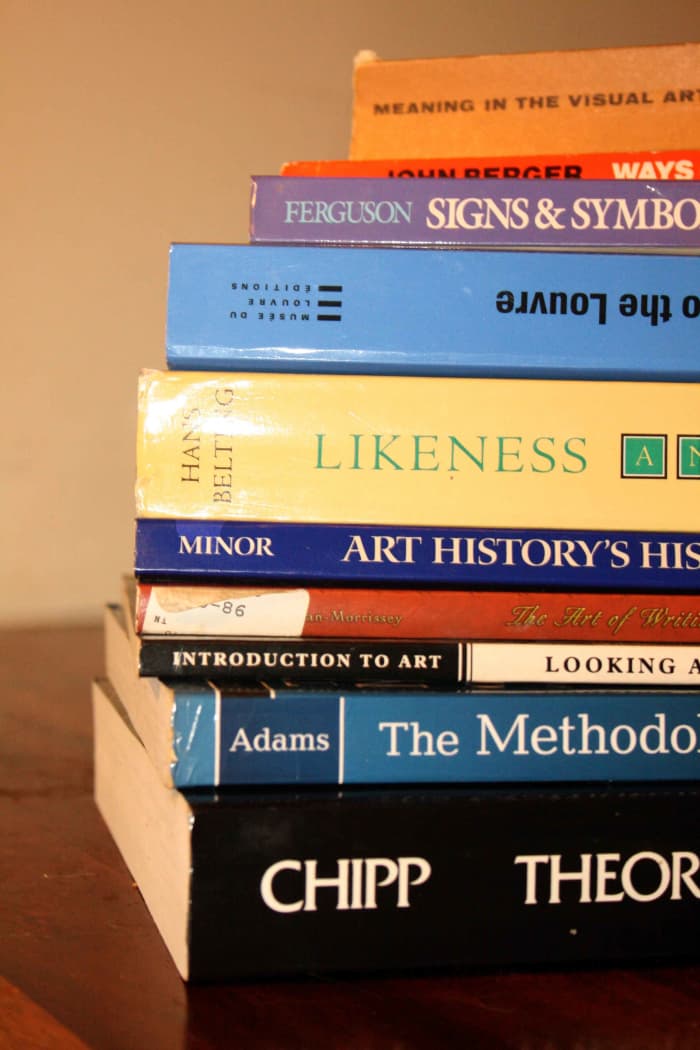
Stack of supplementary art history reading materials.
Photo by RJBarnes
Some Helpful Reference Materials
Some very helpful materials to supplement learning exterior the classroom are:
- For art theory:
- Meaning in the Visual Arts by Erwin Panofsky, ISBN 978-0226645513
- The Methodologies of Art: An Introduction by Laurie Schneider Adams, ISBN 978-0-8133-4450-eight
- Ways of Seeing past John Berger, ISBN 0-14-013515-iv
- For Classical (and Renaissance) fine art: Who's Who in Classical Mythology by Adrian Room, ISBN 0-517-22256-half-dozen
- For Modern fine art: Theories of Modern Art past Herschel B. Chipp, ISBN 978-0-520-05256-seven
- For symbolism in Western Christian art: Signs & Symbols in Christian Art by George Ferguson, ISBN 978-0-nineteen-501432-seven
- Other:
- The Cambridge Introduction to Fine art: Looking At Pictures by Susan Woodford, ISBN 0-521-28647-six
- The Art of Writing near Art by Suzanne Hudson and Nancy Noonan-Morrissey, ISBN 0-15-506154-2
- Art History's History by Vernon Hyde Minor, ISBN 0-13-085133-7
Don't forget to check out biographies of artists and exhibition catalogues for even more in depth supplementary materials.
Some helpful online resources
- Art Project - Google Cultural Found
The Google Cultural Institute brings together millions of artifacts from multiple partners, with the stories that bring them to life, in a virtual museum. - Artstor
The Artstor Digital Library - digital collections of artworks from around the globe. - JSTOR
Journals, primary sources, and now BOOKS
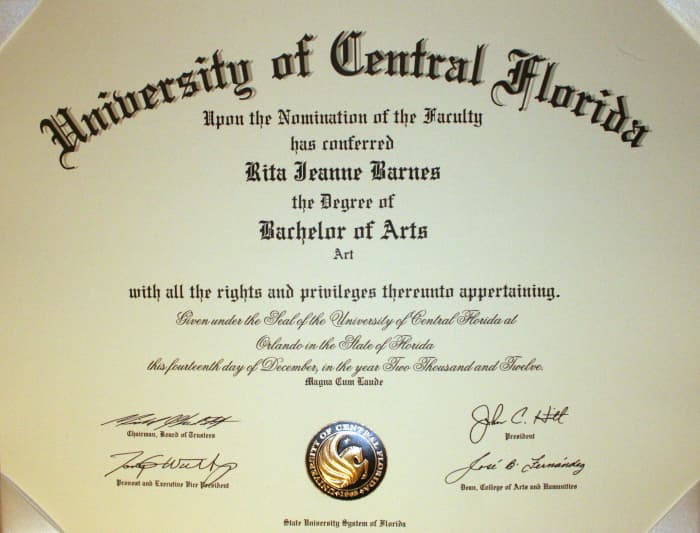
Just for proficient mensurate, this is my diploma showing I graduated with honors and a degree in art history.
Photograph by RJBarnes
In Conclusion
Fine art history is a fascinating subject, and I highly recommend it to anyone who has the slightest interest in fine art. All the same, it is not an easy class, and even those of us who major in the field struggle to make the course. I wish I'd had someone to outline for me the best fashion to approach studying and learning the textile. Instead, I had to learn the hard way. For those of y'all who observe yourself grappling with the textile, I hope this article helps you go the grades you lot deserve.
Alexia on October 21, 2019:
Bang-up tips! Thanks for sharing. you are 100% right about study earlier the form, and write notes during the class.
CANDICE on January 18, 2018:
Your overview with study skills is an academic culture of its own! Slap-up idea to assist students!
I'm 69 with a degree in fine art history , French and biology- 5 years to achieve plus a junior yr in France and a summertime in Florence, Italian republic.
Question for all:
I like the construct for learning each work of art! I did this for myself in learning works of art for myself. I bought postcards of art works everywhere I went-about 1000. I indulged myself in fine art in 1968,69,71,76 meaning I kept on studying!
Again, preparing myself for medical school, I worked in a infirmary to make sure I wanted to be a medico. Without realizing I liked children, I tutored a dr.'southward child in math. I wanted to be bully and aid kids. So, I did 3 masters degrees over viii years in special ed.,counseling psychology and writing curriculum. I never was layed off. I was moved around in grades k-9 over several years. The best part of this story is that posters of art works laid around in the library and were rarely used.
And then, I started pedagogy art history to kids of all ages. I introduced a painting or sculpture and designed a project for my students every calendar week. I taught for 29 years. I was in a French Immersion school for 13 of those years.
QUESTION: People who think they are skillful or keen fine art historians use your model. It's the only field of study I lknow with such a memory impact. Equally far equally teaching goes, there is no like shooting fish in a barrel mode to be an art historian. Having enough courses to interruption down the memory load is the merely solution I encounter. Over 4 years if possible, art history majors could take 2 -3classes per term. That is heavy. They don't all have to be in a sequence. I think doing prehistoric art aligned with the emerging era of modern art could teach some invaluable understandings. Simply an instance. I got all deserved A's because I worked difficult and loved art! I am a great writing instructor through comments through the years. I liked to coach. Neither producing art myself or writing interested me to this day.
What skills did your greatest colleages around the world possess that may have been different simply useful? The style of learning and education to a exam gets one-time fast. Studying foreign languages is very circuitous, simply without a deep agreement of grammer and syntax and vocabulary growth,
those older than second form would struggle without a tutor and adults without instructin carry traverlers' dictionaries for life.
I'm going to comtinue your articles. This is a dandy site! I feel good renewing my retentiveness of what I beloved!
SCREW THIS on December 07, 2017:
I HATE THIS! THIS IS USELESS AND IT GAVE ME NO Assistance! SCREW THIS!
Alan on May 21, 2017:
I found this days after finishing the class. My last ditch attempt for a B came upward curt. I concluded upwardly with a 78%. Really tough class. Studying for the material was really hard. I had to know everything in lecture and everything in book plus research exterior of both if study guide had things left out of both. It was an extrodinarily tough. I got overwhelmed. But I stuck with it and after doing well on mid term newspaper, quizzes and extra credit plus getting attendance points I will have the C. I got one B, 4 Cs and a D, which was taken out every bit lowest score is taken out, on the exams. Only was to accept gotten a B would have been an A on the concluding and I got a 71%. Just I tried my hardest. The studying method might have been a trivial off. Merely too I might have just had information technology likewise tough. I could spend hours on this. Just consider I took two other classes. And was lost with following teacher on notes sometimes I did well.
Lindsey on February 28, 2017:
Go Knights!
Thank you for the corking report tips, I'll utilize them for my art history midterm! :)
Rita Barnes (author) from Florida on December 01, 2016:
Michele, I'yard so happy to hear this article was helpful, and congratulations on that "A" in history of photography!! Y'all got this!
MiWilber on December 01, 2016:
@nmu.edu
Rita,
Thank you for all of this swell data. I am a photography major at NMU and I am freaking out about taking the 3 Fine art History classes I need for my caste. Yes, later taking History of Photography and passing with every bit "A" I know information technology takes hard work and dedication. I'thousand in my early 50's and feel overwhelmed at times with all of this studying. I only don't want my GPA to be affected so I need the grades!
Thanks once again!
Michele
Rita Barnes (author) from Florida on February 10, 2015:
@ weirdalex
I hope this does assist you get through your class. It was many classes and a lot of hours studying before I figured out the all-time way to approach the data. Virtually importantly though, I hope what you learn in your class inspires yous to keep drawing and creating art!
Alana on Feb 09, 2015:
very helpful
thanks
weirdalex on January 10, 2015:
Thanks so much for posting this! I think this is going to help me a lot in my class. I really similar the idea of creating a table for artists and information about them. I love creating art, then I thought I'd dear art history, merely I found the grade (which I'g currently taking for a GE requirement) to be a lot harder and less interesting than I thought. I'm not into history, merely I honey cartoon and such. I think this is going to aid a lot, and I think I'll have a lot more fun studying the subject now. :)
Source: https://owlcation.com/academia/How-to-Study-for-an-Art-History-Exam-and-Get-an-A

Post a Comment for "Lesson 2 Art Hisotry B Final Unit 3 Final Exam"