Most Lines of Poetry Can Be Read in Three Seconds
Stride UP YOUR Poesy GAME WITH BETTER LINE BREAKS AND ENJAMBMENT
What makes a poem, a poem? Long story curt, poetic line breaks. Of class, many other literary elements fuse to make poems croon, but poetry is visibly singled-out from prose considering its lines are sundered before the page's natural cease, at clearly calculated points. Poems are dialogues betwixt the presence that is the text and the absenteeism that is the white space revealed.
In dissimilarity, where a line ends in a prose piece is arbitrarily dictated past a folio'due south margins. Hence why "prose poems," which don't utilize line breaks, are qualified past the word "prose." Every prose line runs blindly towards the brink, and once information technology bumps its head against the uniform white space of the margin (in LTR and RTL scripts), information technology starts again on the next line, replicating this headlong trajectory over and over until you accept pages filled with blocks of text start by just smidgen indents. Prose flows, but it doesn't care where it goes.
Although line breaks build poems, many "writers" have no damn clue how to apply them effectively. If y'all're not taking advantage of the connotative dynamism and aesthetic value of ink abutting blankness afforded by poetic line breaks, you lot're not writing the best poetry. In fact, you're not writing poetry at all.
POETIC LINE BREAKS DEFINITION
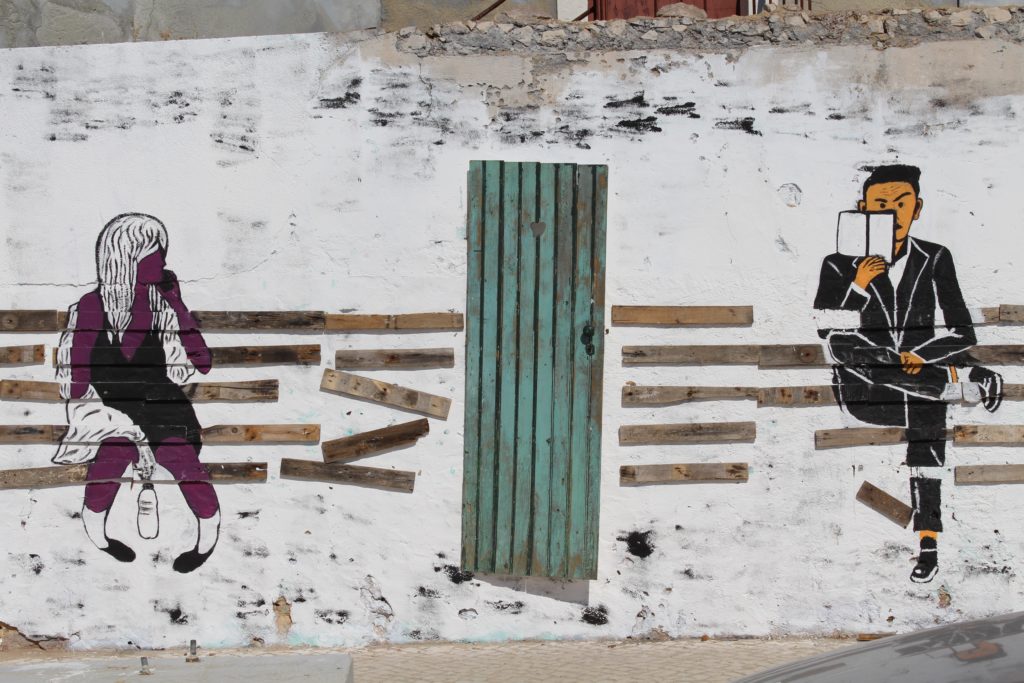
Showtime off, let's define a poetic line break. Quite just:
A poetic line break is the deliberately placed threshold where a line of poetry ends and the next ane begins.
Remember, at that place's a difference between a "line" and a "judgement." A sentence is that course-schoolhouse tool that expresses a complete thought. A line is the literal linear streak of text flowing beyond a page. A line is a container for sentences. A line is a boa constrictor stretched beyond a paper road, and a sentence is the still-whole squirrel in its belly.Here are some rules to remember nigh lines and sentences. (The / beneath represents poetic line breaks and is useful in environments such as this, where space is malleable and digital devices distort).
A poetic line can contain a complete sentence:

A poetic line tin can likewise contain multiple sentences:

A poetic line can likewise contain a sentence and an incomplete judgement:

Or multiple sentences and an incomplete sentence:

Or but an incomplete judgement:

Or even several incomplete sentences:
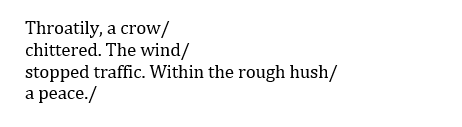
Already y'all tin see that there's much nosotros tin can do within a poetic line. Think of a line equally container, a bottle. Inside it, we let canvas small-scale ships of sentences and their fragment dinghies.
ENJAMBMENT IS THE Key TO THE BEST POETIC LINE BREAKS
Now nosotros get to the good stuff (*rubs easily gleefully*). Poetic line breaks tin can be just as deadening every bit prose's headlong period if we schism every line at an "cease finish." An "stop stop" is just some other word for a period, and a period is simply a little black dot that indicates that a sentence is consummate. If we end at such an obvious end, our poetry becomes predictable, and this is a no-no because poesy's greatest offer is linguistic eurekas. Thus, rather than breaking our lines at the end of each complete sentence, we should "enjamb" them.
Enjambment births judgement fragments, multi-dimensional meaning, and visual appeal through the unexpected intrusion of white space. Enjambment'southward power isn't a secret, merely many "poets" — perhaps including you lot, dear reader — don't fully capitalize on its potential — or worse, use information technology poorly. In a walnut-shell, I call up of enjambment like this:
Enjambment is the betoken where a sentence fissures and continues on to the side by side poetic line."
Let's see how others define enjambment:
The running-over of a sentence or phrase from one poetic line to the adjacent, without terminal punctuation; the opposite of end-stopped."
-The Poetry Foundation
Enjambment, also chosen run-on, in prosody, the continuation of the sense of a phrase beyond the end of a line of poetry."
-Encyclopaedia Britannica
In other words, while I conceptualize enjambment as a betoken on the page, official definitions present it as a linguistic flood. Both modes of thinking about it are useful since enjambment's fruit really grows from the nexus of breaking and continued meaning. Because the specific betoken at where the enjambment occurs can aid yous craft a more stiff line break.
If yous're even so dislocated well-nigh the stardom betwixt enjambment and poetic line breaks, hither's an easy way to remember about it.There are two types of poetic line breaks. One is end-stopped. The other is enjambed. Enjambed line breaks are poetic bullion.
Enjambment tin also exist thought of equally the intimate, subtly interrupted conversation betwixt the final discussion of the enjambed line, and the first word of the subsequent line. The preceding and following words, of class, chime in and contribute to the conversation, only the lover's dialogue happens betwixt those final and first words.
Farther, because the final discussion of an enjambed line bears the precariousness of the brink of white space — generally more white space than its successor — considering information technology teeters on the edge of silence — the poet must ensure that every unmarried terminate word resonates. This holds true even if the poetic line intermission is end-stopped, simply that little pebble that is a period makes the finish-stopped line less vulnerable to the massive blank silence that enjambed final words are exposed to. Similarly, the start word of the subsequent line only has to bear the antecedent uniform margin/gutter, though of course this tin can be played with via indents and stanza breaks, but we'll salvage that for another day.
RULES FOR POETIC LINE BREAKS
In whatever case, in every case, each poetic line break depends upon a critical choice in diction, and an awareness of its ripple effect in audio and meaning. Here are some mandatory tips to reach the best poetic line breaks:
Never stop a poetic line on an article ( a/an, the ). The result will exist incompleteness, rather than dynamic tension.
Never end a poetic line on a conjunction ( and, or, then, nor …). It's meliorate to have such words at the start of the side by side line, but information technology's even better to restructure the lines and then that the conjunction lives hidden amid the momentum of livelier words.
Never end a poetic line on a pronoun ( I, me, mine, his, hers, theirs, yours …). These are words that back-trail, non words that can jut proudly like a figurehead on a ship's prow.
Try really hard not to end a poetic line on a preposition. The event is similar to enjambing on articles and conjunctions, though sometimes the broken prepositional phrase can be interesting.
Line break on unusual nouns and verbs that band strong equally standalone words. Equally we discussed in 8 Primal Literary Elements in Every Written Masterpiece, linguistic poignancy is always crucial, but information technology becomes critical when the strength of your diction is tested by a page's white space.
Nonetheless, be enlightened that enjambment can rejuvenate common, tired words (low-cal, home, breath, and so on) like no other poetic device. Strategic line breaks are a rare opportunity to reclaim these words from their historical overuse by imbuing them with variegated connotations.
Line break at a rhythmic point to poise meaning and weave a sonic tapestry. Luckily, verse has shed its rhyming knickers, but that doesn't mean you lot can't play with rhyme, rhythm, and so on sporadically, internally, and effectively via the pauses and acoustic cascades created by poetic line breaks. At the aforementioned time, these pauses are sonic cues to read differently, assuasive for distinctions and additions in the meaning of your words, fragments, and sentences.
POETIC LINE BREAKS IN Action
Let'south see an example where an opportunity for enjambment isn't capitalized upon:
Example A:

*Shakes head sadly.*
If you lot're a poet, you should exist having a panic set on at the missed opportunities hither. And yet, I tin can't tell y'all how many workshop — and published — poems I've read that miss these opportunities every unmarried time, every single line. If we instead write:
Instance B:
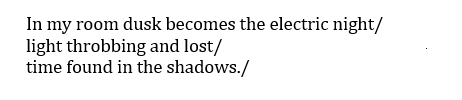
The poem grows a hydra-head of new meanings. Enjambing on "night" means that the container of the offset line now holds the idea of sunset becoming electrifying dark in the room considering the reveal of the artificial night "light" is delayed by the mid-sentence poetic line intermission. Thus, in Example B, dusk is transformed into both the captivating night as a time of day and the literal night calorie-free that gets plugged into electric sockets, while Example A but illustrates the latter.
Farther, in example A, the second line shoots its shot all in one get; at that place's no room for surprise. In contrast, Example B's 2nd line contains an entirely new idea because of where the line begins and end: not only are we gifted the image of the throbbing nighttime calorie-free, and later, lost time found in the shadows, we are likewise given "low-cal throbbing and lost" equally an unexpected standalone nugget of meaning merely because I enjambed on the words "dark" then "lost." This image does non exist in Example A because it wasn't extracted through the clarity of blank space strategically created via enjambment.
Still some other dimension in pregnant in Example B is accomplished through the 2nd line break on "lost", which creates the final container of "time constitute in the shadows." In contrast with Instance A, there'due south an extra gain in Example B — not only has "lost fourth dimension been plant in the shadows," time itself — and thus double time, extra time — is plant there likewise thanks to enjambment.
These are just a few lines, so imagine what yous tin can do in a whole poem if you wield poetic line breaks, and more specifically, enjambment, effectively. They are tools that allow you lot to whittle picayune poems within your larger piece.
It's important to note that enjambment doesn't remove meaning; information technology simply adds different meanings. All of the ideas in Example B are present in Example A, but B contains at least 3 other meanings because of two simple line breaks. At the aforementioned time, be aware that you lot will ofttimes have to choose betwixt additional meanings when employing enjambment. Breaking on one discussion versus another may create an culling, equally powerful sub-meaning, and this is when you have to consider what enjambed connotation works better within the context of your entire verse form.
Also keep in listen that poetic line breaks are an editing tool; they generally come after you kickoff scribble downwardly your creation. This is true for several reasons. If you hand-write your commencement drafts, the lines will probable sprawl out with much wider spacing than what will be in their final typeset form. When the poem gets transferred to the calculator, its entire appearance changes — and since the conversation between all of a poem'southward line breaks and the resulting white space result in an aesthetic that'due south intrinsic to the verse form's issue, yous can't smooth those line breaks until you have a sense of what your poem will look like in its ultimate form.
Secondly, regardless of the mechanics of your composition, editing is a process of both adding and cutting content, so entire lines and words can disappear or rear their heads, drastically altering the look of your poem, and the corresponding enjambment. If yous try to edit co-ordinate to predetermined poetic line breaks, you're going to end upwards with a tortured slice whose corset is too tight to allow its words to breathe.
Poetic line breaks add to a more fulfilling experience, both from a artistic perspective for you equally an artist, and for your readers, breathing shut to pages filled with your words as their night lights throb on and off, on and off.
Source: https://notesofoak.com/discover-literature/poetic-line-breaks-guide/

Post a Comment for "Most Lines of Poetry Can Be Read in Three Seconds"